
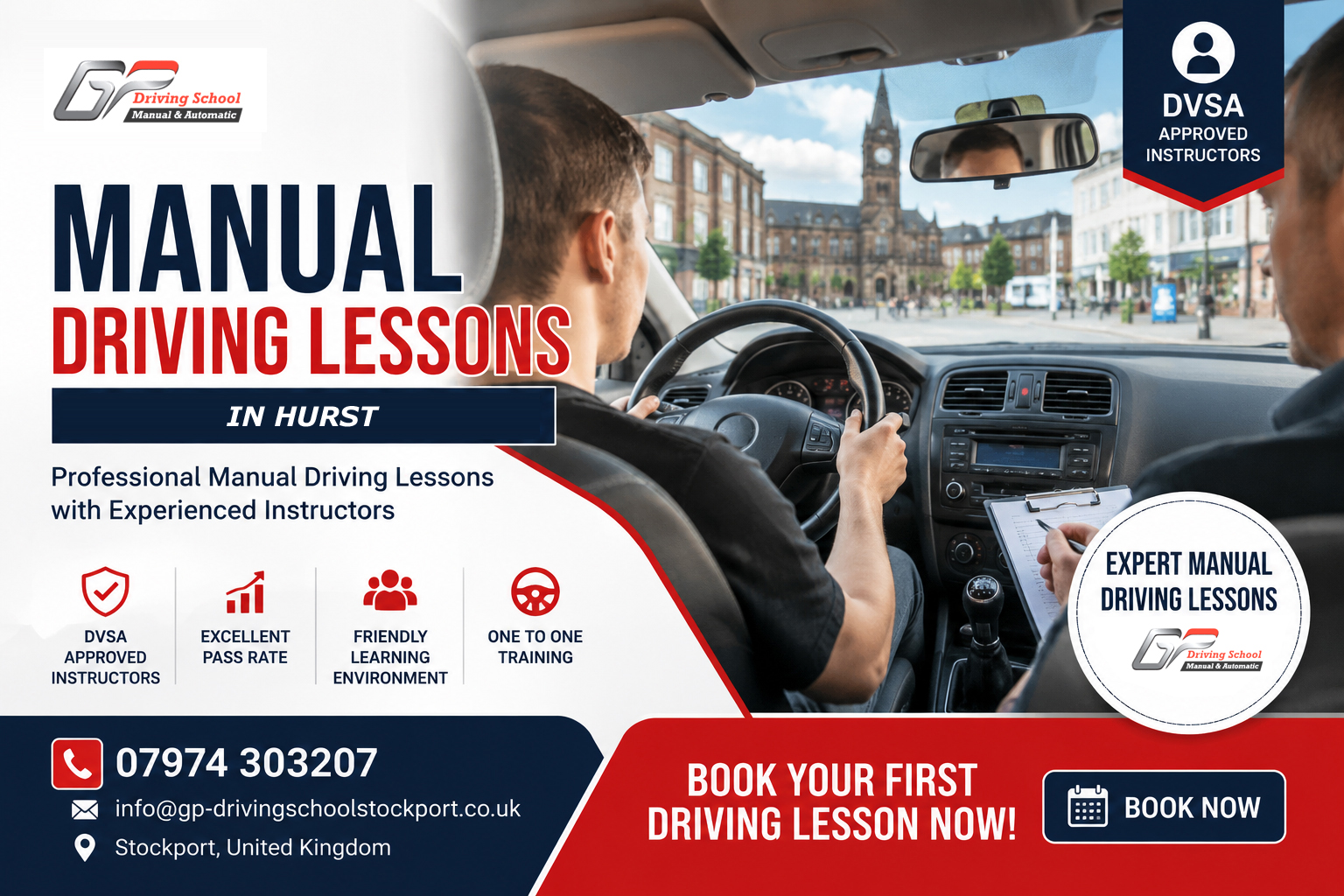
Learning to drive a manual car is an important step towards independence, giving you the freedom to travel for work, education, shopping, appointments, and social activities. If you are looking for manual driving lessons in Hurst, professional driving tuition can help you build the practical skills and confidence needed to become a safe and responsible driver.
GP Driving School Stockport provides manual and automatic driving lessons for learners at different stages. Whether you are sitting behind the wheel for the first time, have already completed some lessons, or need additional preparation before your practical test, your training can be focused around your current ability and individual progress.
Learn Manual Driving With Confidence
Learning a manual car involves coordinating several controls at the same time. You need to use the clutch, accelerator, brakes, steering wheel, and gears while also observing the road and making decisions about other road users. It can feel complicated at first, but with regular practice and professional guidance, these actions can gradually become more natural.
The aim of manual driving lessons should be more than simply helping you pass your driving test. You should develop the ability to control the car smoothly, understand different road situations, anticipate hazards, and make sensible decisions independently.
Why Learn to Drive a Manual Car?
Manual driving gives you greater involvement in controlling the vehicle. You learn how the clutch and gears work together and how different gears affect the way the car responds.
For many learners, developing these skills provides a strong foundation for their future driving. You can become more comfortable with clutch control, gear changes, low-speed manoeuvring, hill starts, and different traffic conditions.
Manual lessons can also help you develop better awareness of how the vehicle responds to your actions. As your experience increases, changing gears and using the clutch can become much less demanding, allowing you to focus more attention on the road.
Manual Driving Lessons for Beginners
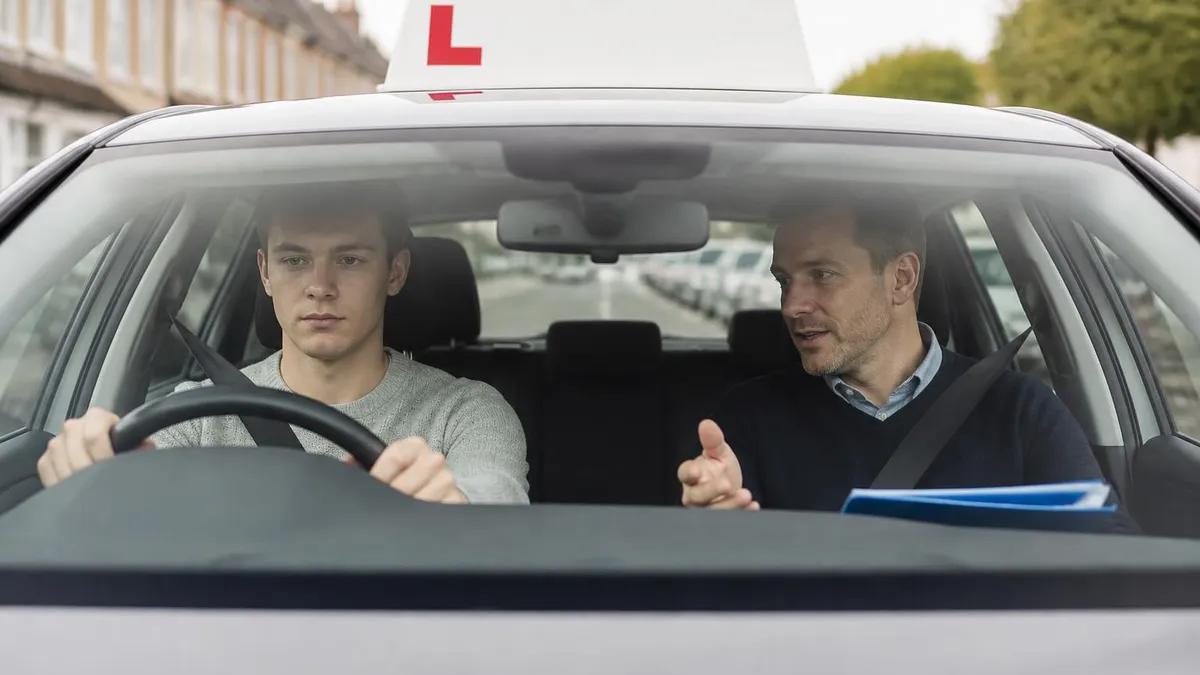
If you have never driven before, there is no need to feel that you should already know what to do. Your first lessons are designed to introduce you to the vehicle gradually.
You can begin by learning about your seating position, mirrors, pedals, steering, gear lever, and other controls. Once you are comfortable with the basics, you can start practising moving away, stopping, steering, and changing gears.
It is completely normal to make mistakes when learning. You might stall the engine or struggle to find the biting point. These experiences are part of learning how the vehicle behaves, and your instructor can help you understand what went wrong and how to improve.
Developing Clutch Control
Clutch control is one of the most important skills for a manual learner. At first, finding the biting point can require a lot of concentration, but repeated practice can make it easier.
During your lessons, you can learn how to use the clutch smoothly when moving away, stopping, reversing, parking, driving slowly, and dealing with traffic.
Good clutch control can make a significant difference to your overall confidence. Once you understand how the clutch responds, you can begin to concentrate more on observation and decision-making.
Learning to Change Gears Smoothly
Gear selection is another essential part of manual driving. Your instructor can teach you how to recognise when a gear change is appropriate by considering your speed, the road ahead, traffic, gradients, and what you need to do next.
With practice, you can learn to change gears without allowing the process to distract you from the road. Smooth gear changes can also help make your driving more comfortable for you and your passengers.
Driving Around Hurst
Learning to drive around Hurst can provide useful experience of everyday road situations. As your confidence grows, you can encounter different junctions, residential roads, traffic conditions, parked vehicles, pedestrians, cyclists, and other road users.
The purpose of learning in a local area is not to memorise individual routes. Instead, you should develop skills that can be transferred to unfamiliar roads.
After passing your test, you will not always know what is around the next corner. Learning how to observe, anticipate, and respond appropriately can therefore be more valuable than simply learning a particular route.
Developing Strong Observation Skills
Observation is one of the foundations of safe driving. You need to be aware of what is happening ahead, behind, and around your vehicle.
During your manual driving lessons, you can develop the habit of checking mirrors, looking further ahead, identifying road signs, watching pedestrians and cyclists, and recognising changes in traffic.
Good observation gives you more time to make decisions. Instead of reacting at the last moment, you can anticipate what might happen and adjust your speed or position accordingly.
Learning Hazard Awareness
Hazard awareness involves recognising potential problems before they become immediate dangers. A parked vehicle might hide a pedestrian, a cyclist could move around an obstruction, or another vehicle may be preparing to emerge from a side road.
Your instructor can help you learn to recognise these situations and respond appropriately.
By looking ahead and considering what other road users might do, you can develop a more defensive and thoughtful approach to driving.
Building Confidence at Junctions
Junctions are an important part of everyday driving and require good observation, planning, positioning, and vehicle control.
You need to understand priorities, approach at an appropriate speed, select a suitable gear, check for other road users, and decide when it is safe to proceed.
Your instructor can introduce different junction situations gradually. As your skills develop, you can begin making more of these decisions yourself rather than relying on constant instructions.
Becoming Comfortable With Roundabouts
Roundabouts can initially be challenging because several things need to be considered at the same time. You may need to select the correct lane, observe approaching traffic, judge safe gaps, maintain your position, and plan your exit.
With professional guidance and repeated practice, you can break the process down into manageable steps.
Your lessons can help you become more comfortable with roundabout approaches, lane selection, mirror checks, gap judgement, positioning, signalling, and safe exits.
Parking and Reversing Practice
Parking is another important skill for anyone who wants to drive independently.
Your lessons can give you opportunities to practise different low-speed situations, including bay parking, parallel parking, reversing, and positioning the car accurately.
Rather than simply memorising a particular sequence of movements, you can learn how the vehicle responds to steering and clutch adjustments. This makes it easier to adapt when parking spaces are different from those you have practised in.
Hill Starts and Manual Control
Hill starts can be a concern for learners who are still developing clutch control. Starting on an incline requires coordination between the clutch, accelerator, and brakes.
Your instructor can explain a suitable technique and give you time to practise it in a controlled way.
As you become more familiar with the process, hill starts can become another normal part of your driving rather than something you feel nervous about.
Driving in Different Traffic Conditions
As your ability improves, your lessons can gradually expose you to more challenging traffic conditions.
You may need to deal with queues, busy junctions, pedestrians, cyclists, parked cars, and vehicles making unexpected movements.
These experiences can teach you the importance of maintaining a safe following distance, looking ahead, controlling your speed, and remaining patient.
You do not need to rush simply because another driver is in a hurry. Good driving involves making safe decisions based on the situation around you.
Lessons for Nervous Learners
Some learners feel nervous before they even begin their first lesson. Others become anxious when they encounter busier roads or unfamiliar situations.
A patient learning environment can make a significant difference.
Your instructor can introduce new situations gradually and explain mistakes without making you feel pressured. As you successfully handle different situations, your confidence can naturally grow.
You do not need to be confident before learning to drive. Confidence is something you can develop through experience.
Additional Tuition for Existing Learners
You may already have completed a number of driving lessons but still feel that certain areas need improvement.
Perhaps you struggle with roundabouts, parking, clutch control, busy traffic, or independent driving. Instead of starting again from the beginning, lessons can concentrate on the areas where you need the most practice.
Focused tuition can help you identify recurring mistakes and work towards becoming more consistent.
Preparing for the Practical Driving Test
When you are approaching test standard, your lessons can become more focused on independent and consistent driving.
You can practise junctions, roundabouts, parking, reversing, independent driving, road positioning, appropriate speed, mirror use, signalling, and hazard awareness.
Your instructor can also help you identify mistakes that repeatedly occur during lessons. Correcting these issues before the test can help you feel more prepared when the time comes.
Learning to Drive Independently
One of the biggest changes during driving tuition is the transition from instructor-led driving to independent decision-making.
At the beginning, you may need instructions about where to go and what action to take. As your ability improves, these prompts can gradually reduce.
You can start deciding when to change gear, how quickly to approach a junction, where to position the car, how to respond to hazards, and which route to take.
This is an important stage because after passing your test, you will need to make these decisions yourself.
Learn From Every Lesson
Mistakes are part of the learning process.
You might stall, select the wrong gear, approach a junction too quickly, or position the car incorrectly. Instead of simply trying to avoid mistakes, it is useful to understand why they happened.
Your instructor can explain what you could have noticed earlier or what adjustment could have prevented the problem.
This helps you develop genuine driving judgement instead of simply memorising instructions.
Developing Good Driving Habits
The habits you develop during your lessons can influence how you drive for years after passing your test.
Regular mirror checks, good observation, appropriate speed, safe following distances, correct positioning, hazard awareness, and patience are all important habits.
You should also learn to consider pedestrians, cyclists, motorcyclists, and other road users rather than focusing solely on your own vehicle.
These habits can help you become a more considerate and responsible driver.
Benefits Beyond Passing Your Test
Learning to drive can provide benefits that go beyond obtaining a licence. It can improve your concentration, observation, patience, planning, decision-making, and confidence.
You also learn to take responsibility for your actions and consider how your decisions can affect other people.
These skills can become part of your everyday driving behaviour and help you deal with unfamiliar situations more confidently.
Manual Driving Lessons for Different Goals
Every learner has a different reason for wanting to drive. You may need a licence for employment, want greater independence, need to travel more easily, or simply want to achieve a personal goal.
Whatever your reason, professional lessons can help you work towards it at a suitable pace.
The important thing is to build a strong foundation rather than rushing through the training.
Manual Driving Lesson Prices
GP Driving School Stockport currently lists a 2-hour manual driving lesson for £76 and a 10-hour manual block for £360.
If you are interested in manual driving lessons in Hurst, it is best to contact the driving school directly to confirm current prices, availability, pickup arrangements, and area coverage before booking.
Why Choose GP Driving School Stockport?
GP Driving School Stockport offers manual and automatic driving tuition with DVSA-approved instructors. The school focuses on one-to-one training and a friendly learning environment, with lessons designed around the learner’s individual ability and progress.
Whether you are taking your first lesson or preparing for your practical test, professional tuition can help you develop vehicle control, road awareness, hazard anticipation, and independent decision-making.
Manual Driving Lessons in Hurst
If you are searching for manual driving lessons in Hurst, GP Driving School Stockport can help you work towards becoming a confident and independent driver.
Your training can begin with the fundamentals of clutch control and gear changes before progressing to junctions, roundabouts, parking, hill starts, busy traffic, hazard awareness, and independent driving.
The aim is not simply to help you pass your driving test. It is to help you develop the skills and judgement needed to continue driving safely once you are on your own.
Contact GP Driving School Stockport
GP Driving School Stockport
Stockport, United Kingdom
Phone: 07974 303207
Email: info@gp-drivingschoolstockport.co.uk
Start Learning to Drive in Hurst
You do not need previous driving experience to begin your journey. With professional guidance, regular practice, and a willingness to learn, you can gradually become more comfortable behind the wheel.
If you are ready to start manual driving lessons in Hurst, contact GP Driving School Stockport to discuss your requirements.
Start with the basics, build your confidence through practice, and work towards becoming a safe, capable, and independent driver.

